- You are here:
- Home »
- Self Publish
Category Archives for Self Publish

Why Self Publishing Works: Complete Author’s Guide
Did you know that nearly half of self-published authors earn over $20,000 each year from their books? The world of self-publishing is expanding fast, giving writers real financial potential and creative freedom that traditional publishing rarely offers. Understanding both the opportunities and challenges of this path can help you navigate the myths and make smarter decisions for your book’s success.
Key Takeaways
| Point | Details |
|---|---|
| Author Control | Self-publishing grants authors complete creative and business control over their work, from editing to marketing. |
| Financial Advantages | Authors can earn higher royalties (35-70%) compared to traditional publishing (8-15%), increasing their overall income potential. |
| Quality Challenges | Despite the benefits, authors must invest in professional services like editing and design to maintain quality in a competitive market. |
| Market Speed | Self-publishing allows for faster time to market, enabling authors to respond swiftly to trends and feedback. |
Table of Contents
- Self Publishing Defined: Core Concepts And Myths
- Types Of Self Publishing Platforms Explained
- How Self Publishing Empowers Author Control
- Financial Realities: Royalties, Costs, And Earnings
- Comparing Self Publishing And Traditional Publishing
- Common Pitfalls And How To Succeed
Self Publishing Defined: Core Concepts and Myths
Self-publishing represents a powerful revolution in book production where authors take complete control of their publishing journey. Unlike traditional publishing routes, self-publishing allows writers to bypass corporate gatekeepers and directly connect with readers through digital platforms and print-on-demand technologies.
According to research from The Guardian, this publishing model has significant economic potential. A 2023 survey revealed remarkable income opportunities: nearly half of self-published authors earned over $20,000, with 28% surpassing $50,000 in annual book revenue. This data challenges traditional publishing narratives about financial sustainability for writers.
Key characteristics of indie publishing include:
- Complete creative control
- Higher royalty percentages
- Faster time to market
- Direct reader engagement
- Flexible pricing strategies
However, self-publishing isn’t without challenges. While democratizing book production, the market faces quality concerns due to reduced editorial gatekeeping. Successful published authors must invest in professional editing, cover design, and strategic marketing to stand out in an increasingly crowded marketplace. Self Publish Archives offer deeper insights into navigating these nuanced publishing landscapes.
Types of Self Publishing Platforms Explained
Indie publishing platforms have revolutionized how authors bring their work to market, offering multiple avenues to transform manuscripts into published books. According to research from Wikipedia, these platforms range from direct DIY digital publishing to more complex service models that provide comprehensive support for writers.
Print-on-demand technology has been a game-changer in non traditional publishing. This innovative approach allows authors to print books only when orders are placed, dramatically reducing upfront inventory costs and financial risk. With best self-publishing platforms, writers can now distribute books globally without maintaining expensive print inventories.
The primary types of self-publishing platforms include:
- DIY Digital Platforms: Direct online publishing with minimal support
- Assisted Self-Publishing: Bundled services with professional guidance
- Hybrid Publishing: Cost-sharing models with partial publisher involvement
- Print-on-Demand Services: Technology-driven printing solutions
Each platform offers unique advantages, but authors must carefully evaluate their specific needs. While some platforms provide extensive marketing support, others focus purely on distribution. Understanding the nuanced differences helps writers select the most appropriate publishing route for their individual goals and budget constraints.
How Self Publishing Empowers Author Control
Author autonomy has been dramatically transformed by indie publishing, giving writers unprecedented control over their creative and professional journeys. According to research from Best Seller Ghostwriting, self-publishing enables creators to make independent decisions about every aspect of their book’s production and distribution.
Traditional publishing barriers have been dismantled, allowing authors to retain complete creative freedom. Self Publish A Book To Boost Your Career highlights how writers can now control critical elements like:
- Book cover design
- Pricing strategies
- Release timelines
- Marketing approaches
- Content editing
The most transformative aspect of self-publishing is its rapid turnaround potential. Authors can potentially complete their entire publishing process in under 90 days, compared to the years-long traditional publishing cycle. This speed empowers writers to respond quickly to market trends, reader feedback, and their own creative impulses, turning publishing from a gatekept process into a dynamic, author-driven experience.
Financial Realities: Royalties, Costs, and Earnings
Self-publishing economics represent a dramatic shift from traditional publishing models, offering authors significantly more favorable financial opportunities. According to research from The Guardian, a 2023 survey of 2,000 self-published authors revealed impressive income potential: nearly half earned over $20,000, with 28% surpassing $50,000 in annual book revenue.
Royalty structures in self-publishing are substantially more lucrative compared to traditional publishing.
 17 Best Self Publishing Companies In 2025 highlights that self-published authors typically earn between 35-70% royalties, compared to traditional publishing’s meager 8-15% range. This dramatic difference means authors retain more of their book’s earnings.
Key financial considerations for self-published authors include:
- Initial production costs (editing, cover design)
- Platform-specific fee structures
- Marketing and promotional expenses
- Potential for higher per-book earnings
- Flexibility in pricing strategies
Successful self-publishing requires treating your book as a business. While the potential for substantial earnings exists, authors must be prepared to invest in professional editing, compelling cover design, and strategic marketing to maximize their book’s financial potential and reader appeal.
Comparing Self Publishing and Traditional Publishing
Publishing pathways represent two distinct approaches for authors seeking to bring their work to readers. According to research from Best Seller Ghostwriting, each route offers unique advantages and challenges that writers must carefully evaluate.
Traditional publishing provides established infrastructure and professional support, including advance payments and industry connections. In contrast, self-publishing empowers authors with complete creative control and significantly higher royalty rates. Self-publishing companies highlight the dramatic differences in financial potential, with self-published authors typically earning 35-70% royalties compared to traditional publishing’s 8-15%.
Key comparative elements include:
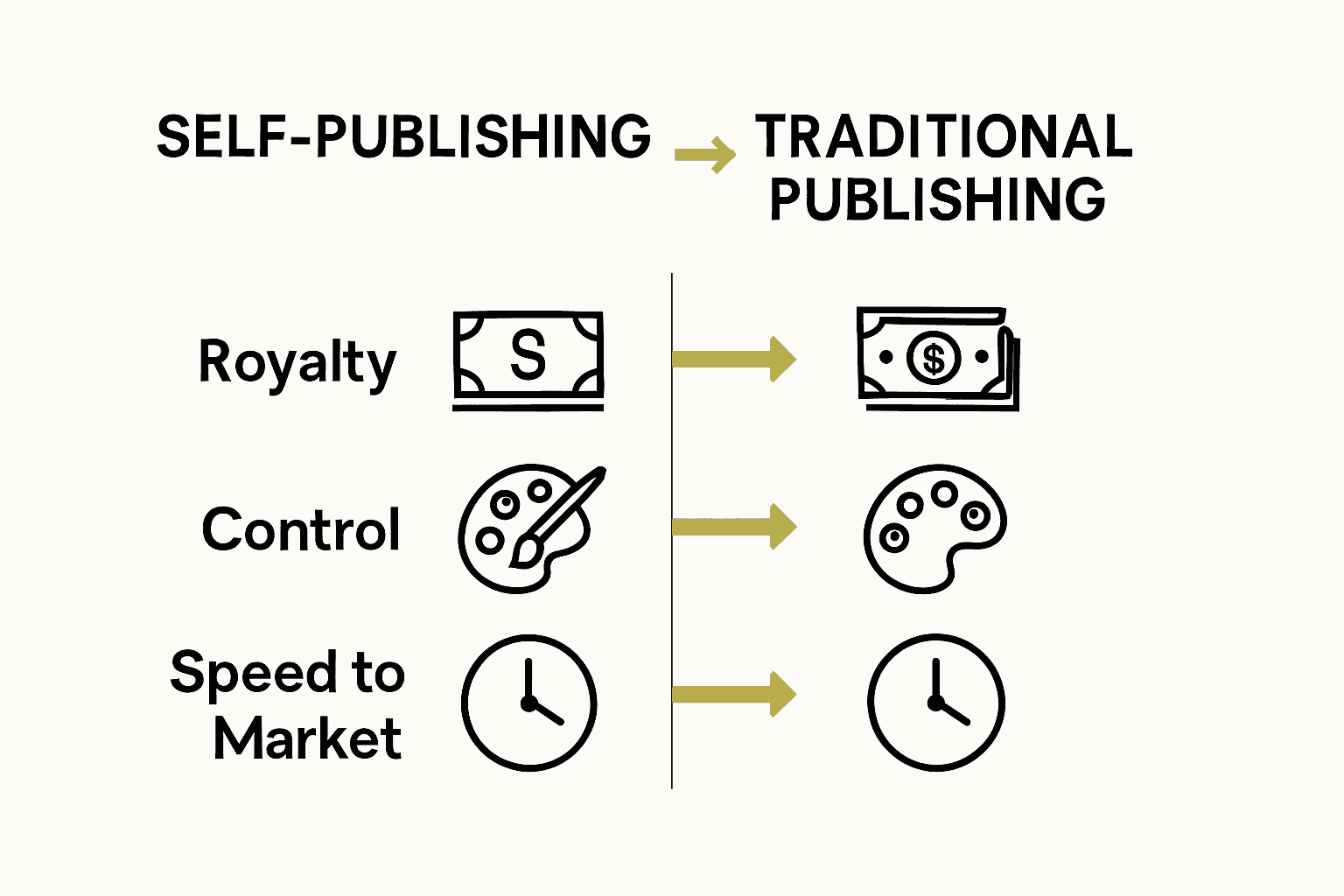
Here’s a side-by-side comparison of self-publishing and traditional publishing models:
| Factor | Self-Publishing | Traditional Publishing |
|---|---|---|
| Creative Control | Full author autonomy | Publisher-driven decisions |
| Royalty Percentage | 35-70% | 8-15% |
| Speed to Market | Weeks to months | 1-2 years |
| Upfront Costs | Author-funded | Publisher-funded |
| Distribution | Author-managed | Established networks |
| Marketing | Author responsibility | Publisher support (varies) |
- Speed to Market: Self-publishing (weeks) vs Traditional (years)
- Creative Control: Full author autonomy vs Publisher-driven decisions
- Financial Investment: Author-funded vs Publisher-funded
- Royalty Percentages: Higher (self-publishing) vs Lower (traditional)
- Distribution Channels: Author-managed vs Established publishing networks
Ultimately, the choice between self-publishing and traditional publishing depends on an author’s specific goals, resources, and willingness to manage their own publishing journey.
 While traditional publishing offers prestige and established support, self-publishing provides unprecedented freedom and potential for direct reader engagement.
Common Pitfalls and How to Succeed
Self-publishing success requires more than simply uploading a manuscript to an online platform. According to The Guardian, the current publishing landscape is incredibly crowded, with millions of titles competing for reader attention.
Authors must approach self-publishing as a professional endeavor, not just a creative outlet. Professional production quality becomes critical—this means investing in:
- High-quality cover design
- Professional editing
- Targeted marketing strategies
- Consistent author branding
- Strategic pricing and distribution
The most common mistakes self-published authors make involve underestimating the business side of publishing. Email Marketing Archives suggest that building a robust reader communication strategy is just as important as the book itself. Successful self-publishers treat their books like a business, continuously learning, adapting, and investing in their craft and market understanding. Visibility isn’t guaranteed—it’s earned through persistent, strategic effort and a commitment to producing exceptional work that resonates with your target readers.
Ready to Master Self Publishing and Grow Your Author Brand?
You already know self publishing gives you creative control and better royalties, but turning your manuscript into a bestseller takes more than just uploading your book. If you feel overwhelmed by marketing, building a loyal reader base, or using the right technology to cut through competition, you are not alone. Many writers hit the same roadblocks featured in our guide: standing out, connecting with readers, and creating reliable book sales.
Now is the perfect time to transform your strategy and reach more readers. Discover how Digital Marketing Authors makes it simple to automate sales, grow your fanbase, and scale your author business with proven digital marketing and AI solutions. If you are ready to take charge of your publishing results instead of relying on luck or noisy marketplaces, visit our site for expert guidance. Claim your path to sustainable book profits and author independence today.
Frequently Asked Questions
What are the key advantages of self-publishing for authors?
Self-publishing offers several significant advantages, including complete creative control, higher royalty rates (35-70% vs 8-15% in traditional publishing), a faster time to market, and the opportunity for direct engagement with readers.
What challenges do self-published authors face?
Self-published authors often encounter challenges such as quality control issues due to reduced editorial oversight, the need for professional services (like editing and cover design), and the responsibility of handling marketing and distribution themselves.
How do self-publishing royalties compare to traditional publishing royalties?
Self-published authors typically earn between 35-70% in royalties, while traditional publishers generally offer only 8-15%. This substantial difference highlights the financial benefits of self-publishing for authors.
What are the primary types of self-publishing platforms available?
The main types of self-publishing platforms include DIY digital platforms for direct publishing, assisted self-publishing services that offer professional support, hybrid publishing models that involve shared costs, and print-on-demand services that print books as orders are placed.
Recommended

17 Best Self Publishing Companies In 2025
The 17 Best Self-Publishing Companies for Authors in 2025
Self-publishing has never been more accessible, but with so many options available, choosing the right platform can be overwhelming. Whether you’re looking for the 17 best self publishing companies to sell your book, an aggregator to distribute it across multiple retailers, or services to assist in the publishing process, this guide will help you make an informed decision.
📌 The Big Five: The Top Self-Publishing Companies
These are the five major self-publishing platforms that dominate the industry and where most authors make the bulk of their income.
1. Amazon Kindle Direct Publishing (KDP)
Amazon KDP is the largest self-publishing platform, allowing authors to publish eBooks and paperbacks for free.
✅ Pros:
- Highest market share in book sales.
- 70% royalty on books priced between $2.99-$9.99.
- Kindle Unlimited offers an additional revenue stream.
❌ Cons:
- Exclusive requirements for KDP Select restrict distribution.
- Competitive market, making visibility a challenge.
2. Apple Books
Apple Books allows authors to sell directly to iPhone, iPad, and Mac users without exclusivity requirements.
✅ Pros:
- Higher profit margins than Amazon in many cases.
- Integrated into the Apple ecosystem.
❌ Cons:
- Less market reach than Amazon.
- Can be challenging to set up without a Mac.
3. Kobo Writing Life
Owned by Rakuten, Kobo is a popular alternative to Amazon, especially in Canada, Europe, and Japan.
✅ Pros:
- No exclusivity requirements.
- Strong international presence.
- Offers promotional opportunities through Kobo’s partner programs.
❌ Cons:
- Limited market share in the U.S.
- Less visibility compared to Amazon and Apple Books.
4. Barnes & Noble Press
Barnes & Noble’s self-publishing arm offers access to Nook eReaders and the company’s website.
✅ Pros:
- Easy distribution to Barnes & Noble customers.
- Potential to be stocked in physical stores (though not guaranteed).
❌ Cons:
- Limited reach compared to Amazon.
- No major promotional tools.
5. Google Play Books
Google Play Books allows authors to sell eBooks to Android and Chromebook users without exclusivity.
✅ Pros:
- Direct access to Android and Google users.
- No exclusivity requirements.
❌ Cons:
- Setup can be complicated.
- Less effective advertising and promotional tools.
📌 The Best Platform for Selling Direct
6. Shopify: Selling Books Directly to Readers
For authors looking to build a direct sales channel, Shopify is the best eCommerce platform.
✅ Pros:
- Full control over pricing and profits.
- No revenue cuts—100% of your earnings go to you.
- Allows authors to create an email list for future marketing.
❌ Cons:
- Requires effort to drive traffic.
- Monthly fees apply.
📌 The Best Aggregators: Distribute Your Book Everywhere
Aggregators help authors distribute their books to multiple platforms without needing to upload manually.
7. Draft2Digital
Draft2Digital distributes books to Apple, Kobo, Barnes & Noble, and more, simplifying the self-publishing process.
✅ Pros:
- Free to upload (they take a 10% commission on sales).
- Converts Word documents into professional eBook formats.
❌ Cons:
- No direct access to Amazon KDP (must be uploaded separately).
8. PublishDrive
PublishDrive offers a subscription-based model instead of taking a percentage of royalties.
✅ Pros:
- Best for high-volume authors who want to save on commission fees.
- Expansive global distribution.
❌ Cons:
- Subscription fees apply, which may not be worth it for beginners.
9. IngramSpark

IngramSpark distributes print and eBooks to bookstores, libraries, and online retailers.
✅ Pros:
- Best for getting print books into physical bookstores.
- Extensive global distribution network.
❌ Cons:
- Uploading fees (unless waived through promotions).
- No guarantee bookstores will stock your book.
📌 The Best Audiobook Distribution Platform
10. Findaway Voices
Findaway Voices allows authors to distribute audiobooks to multiple retailers, including Spotify, Apple Books, and Google Play.
✅ Pros:
- Distributes beyond Audible (which is Amazon-exclusive).
- Allows authors to set their own pricing.
❌ Cons:
- Audible (Amazon’s audiobook platform) has a much larger market share.
📌 The Best Self-Publishing Tools & Services
These platforms help authors with book research, formatting, and marketing.
11. Publisher Rocket (for Amazon Keyword Research)
Helps authors find profitable categories and keywords to maximize book sales.
✅ Pros:
- Provides category and keyword data for Amazon books.
- Helps improve book visibility.
❌ Cons:
- Focused only on Amazon optimization.
12. Atticus (for Formatting & Writing)
A professional book formatting tool that simplifies the process of creating eBooks and print books.
✅ Pros:
- Affordable one-time purchase.
- Great for authors who want professional book formatting.
❌ Cons:
- Lacks advanced editing features.
13. ProWritingAid (for Editing & Proofreading)
An AI-powered grammar, spelling, and style checker designed for authors.
✅ Pros:
- Ideal for long-form content like books.
- Offers a lifetime purchase option.
❌ Cons:
- Requires manual implementation of changes.
14. AutoCrit (for Manuscript Analysis)
AutoCrit compares your book’s writing style to best-selling novels in your genre.
✅ Pros:
- Helps authors improve pacing, dialogue, and readability.
❌ Cons:
- Requires manual work to apply suggestions.
📌 The Best Cover Design & Illustration Services
15. Miblart
A professional book cover design service with affordable pricing.
✅ Pros:
- Custom designs at a fraction of high-end designer prices.
- Offers branding kits and social media graphics.
16. GetCovers
A budget-friendly book cover service for indie authors.
✅ Pros:
- Covers start at just $10.
- Great for first-time authors on a budget.
📌 The Best Ghostwriting & Author Services
17. The Urban Writers
A marketplace for ghostwriting, editing, and book marketing services.
✅ Pros:
- Offers pre-vetted ghostwriters for fiction and non-fiction.
❌ Cons:
- Higher-quality writers come at a premium cost.
🎯 Final Thoughts: Which Self-Publishing Platform is Right for You?
🔹 If you want the highest sales potential → Amazon KDP
🔹 If you want to go beyond Amazon → Apple Books, Kobo, Barnes & Noble
🔹 If you want to sell direct → Shopify
🔹 If you want wide distribution → Draft2Digital or PublishDrive
🔹 If you want bookstore access → IngramSpark
🔹 If you want audiobook distribution → Findaway Voices
🔹 If you need author tools → Publisher Rocket, Atticus, ProWritingAid
The right self-publishing companies depends on your goals—whether you want maximum sales, wide distribution, or full control over your book’s success. Choose wisely and happy publishing!
Self Publish A Book To Boost Your Career
If you are serious about skyrocketing your career, listen up .There is one thing that will give you instant credibility in your field. It’s a book and it’s easier to self publish than you think.
Straight off the bat I’ll tell you that I love Amazon, especially Amazon Kindle Publishing. For the first time in history both you and I can publish a book, express our opinions and have our words read, debated and maybe even loved, all on the same platform. And it’s not going to break the bank.
But if our work is considered crap, no problem. We just start again……until we get it right.
And speaking of crap, let’s talk about 50 Shades of Grey. Not my opinion incidentally as I have not read it. But according to my literary friends (the ones stepping out of their rusted VW Beetles wearing kaftans) and some pontificating literary agents (wannabe writers who couldn’t make it) tell me this 100 million selling series is ‘utter garbage’. Are they right or just bitter and twisted?
Well thanks to Amazon, E L James was able to self publish her books which at one time accounted for 25% of all books sold in the world. Now that’s the kind of rubbish I want to write!
James’s books were eventually picked up by a publisher who got them into bookstores around the world. The movie grossed over $600 million which is not bad for a ‘garbage book’ either.
There are plenty of other titles that do not suit traditional publishers. Some of these old war horses are adverse to risk and it’s difficult to break in. Amazon is one platform that allows fledgling writers the opportunity to self publish and boost their careers.
Creating Your Own Genre
Most traditional publishers want to put you into a box. There’s a certain number of words required, the book can only be in print format and it must be a standard size and so the list goes on. Amazon throws those rules out the window and allows you to write short stories. They have a specific section called Kindle Short Reads. On their print platform CreateSpace, you can print standard size paperbacks or larger ones. No problem.
A Book Sets You Apart
Let’s say you are a dentist and you want to build your client base particularly amongst young children. You have a passion for preventative care of children’s teeth by educating them on how to look after their teeth and gums.
But let’s face it that sounds like a boring topic to write about. Rightly so it would be difficult to imagine such a book rushing out the door and becoming a bestseller. I don’t think Spielberg will be knocking on your door to create a movie from your book.
But that’s not to say you shouldn’t write a book. It will definitely give you credibility. But instead of making it a boring practical journal why not write say a children’s story about a bear with a sore tooth. A fun tale with a message of looking after your teeth could be easily portrayed. Parents would love the book and kids may happily brush their teeth more often.
Can’t Write Or Have No Time To Write
You have a couple of choices – do it yourself or pay somebody else to do it for you. It may mean that you have to get up at 5 am and put in a couple of hours of writing before work. You may have to do it after dinner. But if you want to write the book then you’ll need to make time. Period.
But if early morning starts doesn’t float your boat, perhaps you could hire a ghostwriter. Google the term and you’ll be overwhelmed with choice.
Will a book make you rich?
Possibly but most likely not. The purpose of the book is to differentiate you from your peers. Set you apart. It will open up other opportunities for you which will lead to more credibility and income earning possibilities. And you may make some serious coin from the book as well but don’t hold your breath.
So writing a book has huge upside. Amazon has made it so much easier to self publish your work. It’s easier than it’s ever been. Want to take your career to the next level? The ball is in your court.