
- You are here:
- Home »
- author resources
Tag Archives for " author resources "
Top Social Media Tools for Book Marketing – Expert Comparison 2025
Every author wants to reach more readers and sell more books, but finding the right tools and advice can feel overwhelming. There are platforms out there promising shortcuts, easy wins, or expert coaching, yet it can be tough to know which actually delivers. Some focus on smart marketing systems, some make book design a breeze, and others offer powerful ways to build your audience and stay connected without getting lost in technical details. Imagine discovering a resource built just for writers that puts practical ideas within reach, whether you want to polish your book cover, grow your email list, or plan your next big release. The real question is which solution best matches your goals and energy. Each offers a different path to success and hidden advantages waiting to be uncovered.
Table of Contents
Digital Marketing Authors
At a Glance
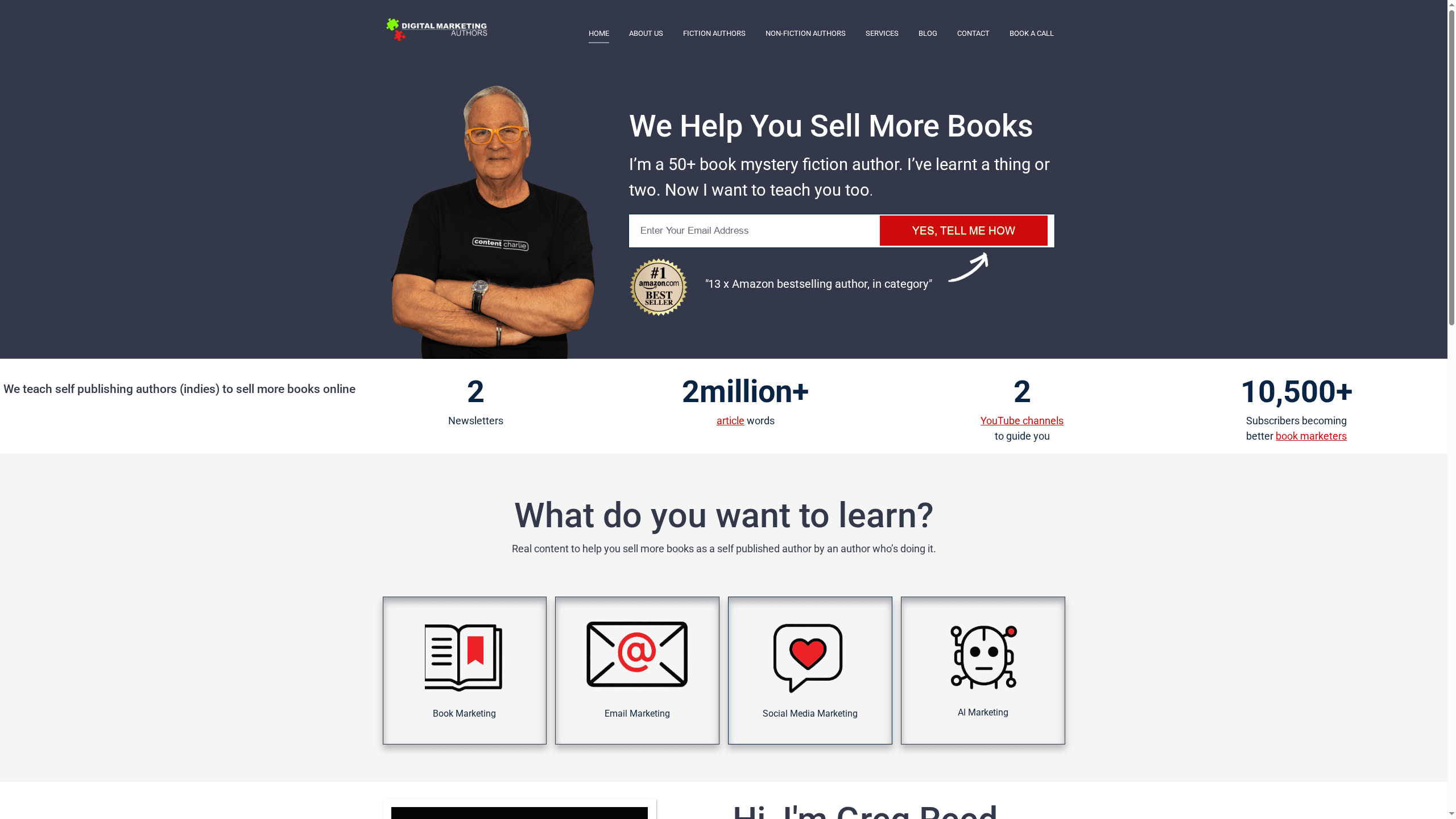
Digital Marketing Authors is a focused, author-first marketing resource that gives indie and self-published writers repeatable systems to sell more books. Founded by 13x #1 Amazon bestselling author C.T. Mitchell, the platform pairs author credibility with practical tactics in email, social media, and AI-driven marketing. If you want training, checklists, and step-by-step guidance aimed specifically at authors (not generic marketers), this is built for you. Expect hands-on strategies rather than vague theory.
Core Features
Digital Marketing Authors delivers targeted guides and training on email marketing, social media promotion, AI-assisted marketing, and content creation designed for book launches and ongoing audience growth. The site bundles strategic playbooks — like list-building funnels and magnetic email sequences — with resource articles such as marketing checklists and tool comparisons. Training materials emphasize automation and reader-community building, helping authors move from one-off promotions to scalable systems that consistently convert readers into repeat buyers.
Pros
- Led by a proven author-marketer: The platform is founded by 13x #1 Amazon bestselling author C.T. Mitchell, so guidance is grounded in real publishing experience and measurable results.
- Author-specific focus: Materials are tailored for self-published and indie writers, meaning examples, templates, and timelines reflect book marketing realities rather than broader corporate campaigns.
- Comprehensive, practical resources: The site includes checklists, tool comparisons, and step-by-step tutorials that let you implement tactics immediately rather than spending weeks learning theory.
- Modern marketing with AI integration: Training explicitly covers AI-powered techniques to save time and boost discoverability, keeping your marketing current and efficient.
- Proven sales and engagement methods: The platform prioritizes systems that grow email lists, automate sales funnels, and nurture a loyal reader base—methods proven to increase book sales over time.
Who It’s For
Digital Marketing Authors is ideal for self-published and indie authors who want to take control of their book marketing with systems that scale. If you write fiction or nonfiction and are committed to learning and applying practical tactics—email funnels, social media promotion, and AI-assisted content creation—this platform will accelerate your results. It’s particularly useful for authors who prefer actionable templates and checklists over academic marketing advice.
Unique Value Proposition
Digital Marketing Authors stands out because it combines frontline author credibility with explicit, execution-focused marketing systems. Unlike generic marketing platforms, it translates book marketing into repeatable playbooks: list-building tactics, automated email sequences, social media content calendars, and AI workflows tailored to book discovery. The emphasis on building a loyal reader army and automating sales moves authors away from one-hit launches and toward sustainable revenue. Backed by a bestselling author, the guidance is both strategic and granular — from subject-line formulas to promotion timing — making it superior for authors who need results without reinventing the wheel.
Real World Use Case
An independent mystery author uses the platform to grow an email list via targeted lead magnets, schedules a four-week social campaign for a new release, and deploys AI to create promotional copy and audience segments. The result: higher open rates, more preorders, and a measurable uplift in long-term reader engagement.
Pricing
Not specified on the website.
Website: https://digitalmarketingauthors.com
Kindlepreneur
At a Glance
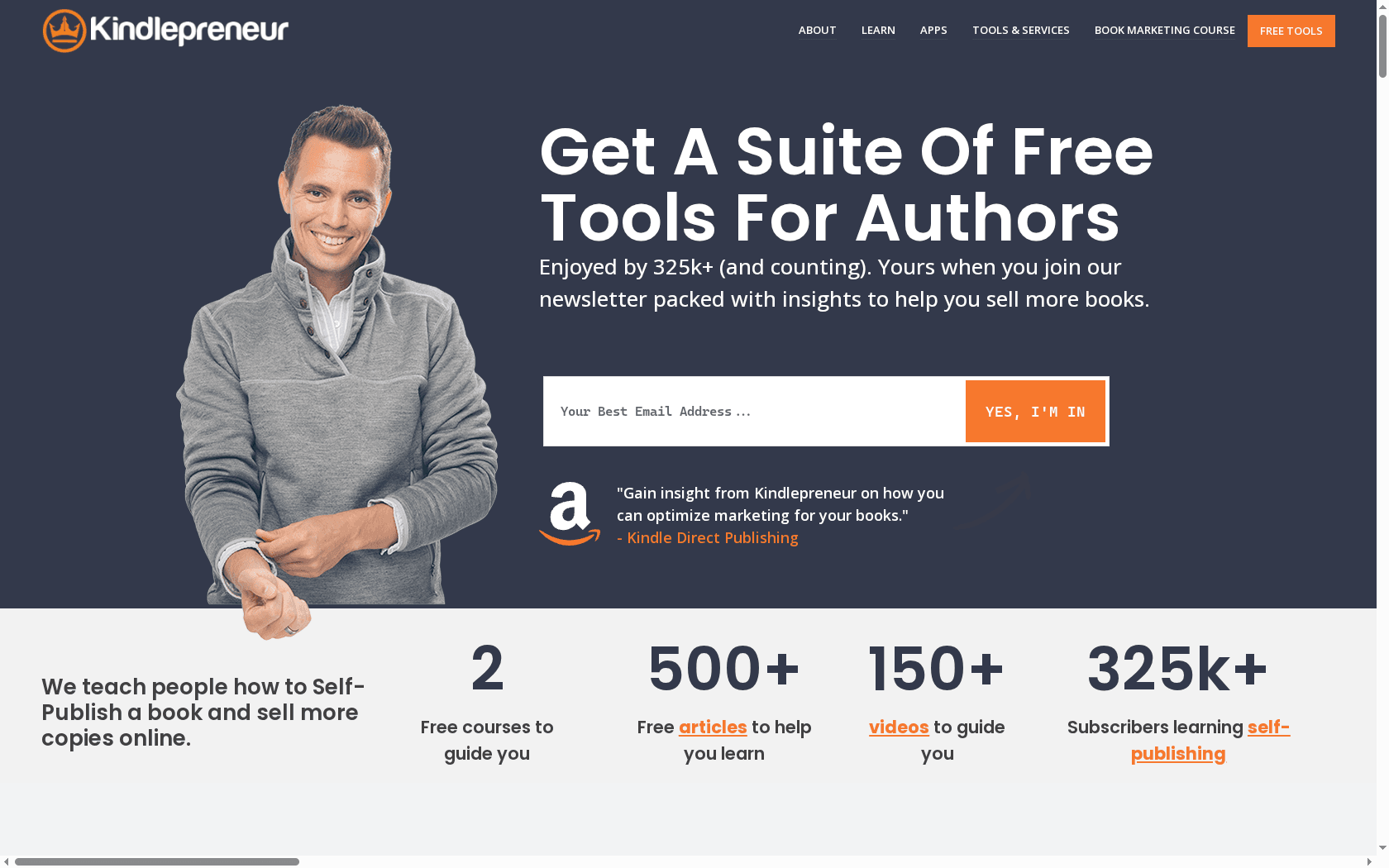
Kindlepreneur is a deep repository of free education and hands-on tools created for self-publishing authors who want practical, Amazon-focused book marketing help. Founded and curated by Dave Chesson, it combines more than 500 articles, 150+ videos, and a collection of free utilities that authors can use without a credit card. If you sell (or plan to sell) through Amazon KDP, Kindlepreneur delivers high-value, actionable material; outside Amazon, its relevance tapers off. Bottom line: a must-visit hub for Amazon-centric indie authors.
Core Features
Kindlepreneur’s core is educational content plus utility tools: free courses on self-publishing and book marketing, a library of over 500 written guides, 150+ instructional videos, and practical tools such as an Amazon sales rank calculator, book description generator, and QR code creator. The site also hosts resources on branding, cover design, editing, formatting, and publishing workflows—packaged to move an author from confusion to measurable action steps.
Pros
- Extensive free content: Kindlepreneur offers hundreds of articles and many videos so you can learn multiple aspects of publishing without immediate cost.
- Practical tools for Amazon sellers: Tools like the sales rank calculator and description generator give you quick, usable metrics and assets to improve listings.
- Authored by an experienced strategist: Guidance comes from a recognized self-publishing expert, which helps the advice feel grounded and credible.
- Supports all experience levels: Whether you’re writing your first indie novel or you’re a seasoned indie marketer, the site includes beginner courses and advanced tactics.
- Large engaged audience: A community of over 325,000 subscribers signals ongoing value and regular updates.
Cons
- Amazon-centric focus can limit applicability: The content and tools primarily target Kindle Direct Publishing, which reduces usefulness for authors pursuing other retailers or non-Amazon strategies.
- Some features behind paywalls: While most resources are free, certain advanced tools or courses may require payment or upgrades to access full functionality.
- Variable fit depending on skill level: The quality and usefulness of specific articles or tools can vary based on where you are in your author journey and your prior knowledge.
Who It’s For
Kindlepreneur is ideal for indie authors, self-publishers, and indie marketers who rely on—or plan to rely on—Amazon KDP as a primary sales channel. If you want step-by-step tutorials, free calculators, and tactical advice that you can apply the same day, this site was built for you.
Unique Value Proposition
Kindlepreneur stands out by pairing deep, free educational content with immediately actionable tools focused on Amazon performance. That combination lets authors both learn strategic concepts and run the tiny experiments that move visibility and sales.
Real World Use Case
An indie author uses Kindlepreneur’s Amazon sales rank calculator to estimate daily sales, applies learnings from articles to refine their Amazon Ads, and follows a free course to tighten book descriptions and metadata—resulting in clearer listings and measurable uplift in visibility.
Pricing
Free tier available; some premium tools and services may require payment.
Website: https://kindlepreneur.com
Book Brush
At a Glance
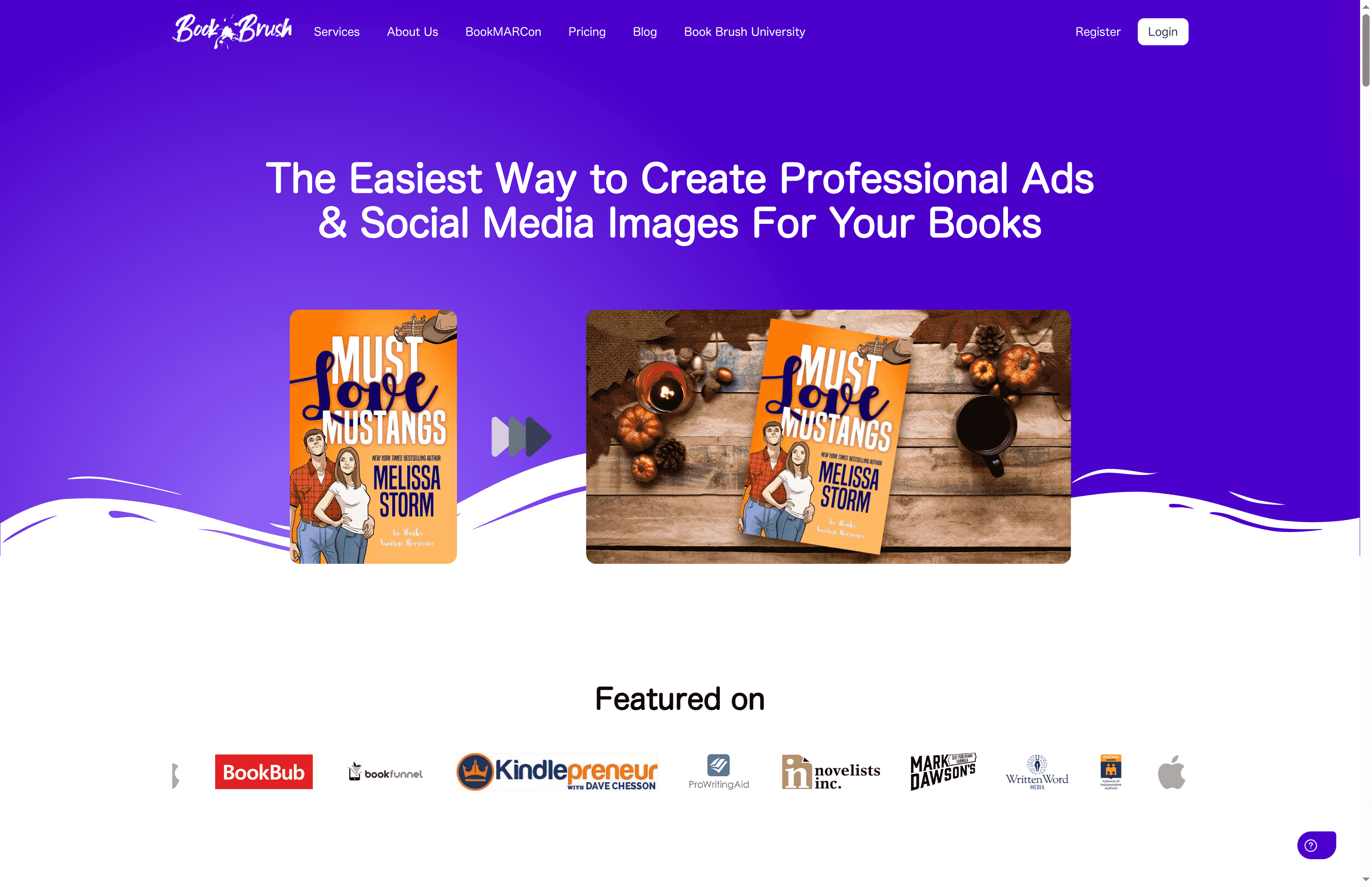
Book Brush is a purpose-built visual toolkit that helps authors produce professional covers, ads, mockups, and animated promos without hiring a designer. Its template library and 3D mockup options accelerate campaign-ready assets, making it a practical choice for busy indie authors and small publishers. It’s not a full-featured photo editor, though — expect convenience over pixel-perfect control.
Core Features
Book Brush bundles a large template library (over 3,000 templates) organized by platform and genre, a cover creator with hundreds of templates, and more than 200 fully customizable 3D book templates for instant mockups. The platform supports box set creation with spine options and uploads for print, ebook, audio, and other formats, and produces animated mockups and social-media-ready videos. Additional capabilities include a reader hub for sharing images, brand-consistent custom design integration, social media management services, and full-service author branding and design services.
Pros
- User-friendly interface with a wide variety of customizable templates: The platform’s organized template library lets you find genre-appropriate layouts quickly so you can build promos in minutes.
- Time-saving tools such as instant mockups and cover creators: Instant mockups and pre-built cover templates dramatically reduce the hours spent assembling campaign images.
- Affordable alternative to hiring graphic designers: For authors on a budget, Book Brush bundles many design needs into one subscription, which commonly costs less than multiple freelance jobs.
- Comprehensive suite of marketing tools tailored for authors: From covers to animated videos to box sets, the feature set maps closely to the typical tasks of book launches and ongoing promotions.
- Ability to create a consistent brand presence across multiple formats: Integration of custom designs and templated assets helps maintain cohesive branding across social posts, ads, and storefront imagery.
Cons
- Limited information on advanced editing features or unique customization options: The platform appears to favor templated workflows over deep, pixel-level editing, which may frustrate authors who want fine-grained control.
- Pricing plans may be expensive for some individual authors or small publishers: Annual plans starting at $149 may be a stretch for authors just testing paid promotion or those with very tight budgets.
- Potential learning curve for new users unfamiliar with graphic design tools: While templates simplify many tasks, authors new to visual tools may still need time to master branding consistency and animation options.
Who It’s For
Book Brush is ideal for indie authors, self-published writers, and small publishers who want fast, polished visual assets without outsourcing. If you run your own book launches and need social ads, mockups, and cover variants produced quickly, Book Brush gives you the assembly line you need.
Unique Value Proposition
Book Brush’s strength is convenience: it packages author-specific design templates, 3D mockups, animated social content, and basic brand services into a single, author-focused platform—so you can move from concept to campaign in hours instead of days.
Real World Use Case
An author preparing a release uses Book Brush to design the book cover, create promotional social graphics, generate animated teaser videos, and produce consistent box set imagery for retailer pages and ad campaigns.
Pricing
Plans range from $149/year for the Plus plan to $246/year for the Platinum plan, with higher tiers offering unlimited downloads, trailer creators, additional mockups, and webinars.
Website: https://bookbrush.com
StoryOrigin
At a Glance
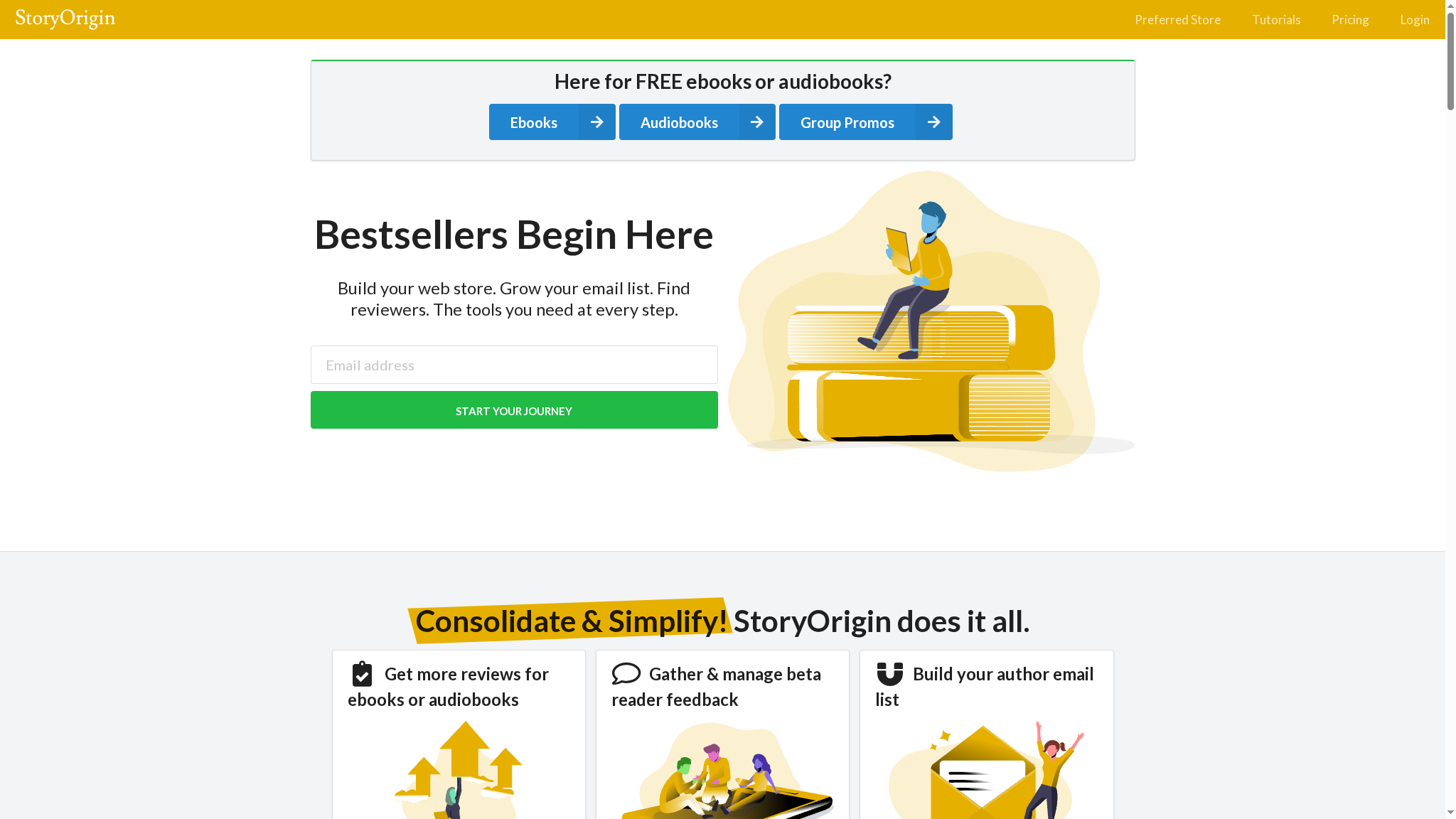
StoryOrigin is an all-in-one author marketing hub built to help indie and traditionally published authors grow mailing lists, manage reviews, and run collaborative promotions without juggling half a dozen separate tools. It combines list-building, reviewer outreach, newsletter swaps, and universal links into a single platform, which can save time and reduce manual follow-up. That breadth is StoryOrigin’s biggest strength — but the payoff requires a learning curve and, for many useful features, a paid plan.
Core Features
StoryOrigin’s capabilities center on streamlining author workflows: build email lists with reader magnets and landing pages; find, vet, and distribute review copies for ebooks and audiobooks; create and coordinate newsletter swaps and group promos; and generate universal links that send readers to the best store per country or preference. It also offers audiobook promo code distribution, beta reader feedback with embedded questionnaires, built-in calendars and campaign planners, writing goal tracking, and automation for reviewer follow-up and download delivery.
Not everything is surface-level. Many tasks that usually require spreadsheets or separate services—review tracking, universal links, and promo coordination—are automated inside the platform. That saves mental overhead. And yes, you can build a basic author website here, too. Small wins add up.
Stop. Think.
Pros
- All-in-one platform reduces tool sprawl: By combining list-building, review management, promotions, and universal links, StoryOrigin cuts the need to cobble together multiple services. This centralization saves time and reduces errors.
- User-friendly interface with depth: The platform is described as easy to use while still offering a long feature list, making it approachable for authors who want more than a single-purpose app.
- Strong community and positive social proof: The product benefits from a supportive author community, which can accelerate learning and provide promo partners.
- Flexible promotional options: Newsletter swaps, group promos, and automated reviewer workflows give authors multiple ways to reach readers and coordinate with other authors.
- Comprehensive review and feedback tracking: From ARC distribution to embedded beta-reader questionnaires, StoryOrigin helps you collect and manage feedback systematically.
Cons
- Complex for new users: Because StoryOrigin bundles many features, initial navigation can feel overwhelming, especially for authors who prefer minimal tools.
- Key features behind paid tiers: Several of the most useful capabilities—group promos, newsletter swaps, and advanced review management—require the Standard plan, limiting the free tier’s practicality.
- Limited free features: The free basic plan exists, but most authors aiming for real list growth and promo coordination will need to upgrade to access value-driving tools.
Who It’s For
StoryOrigin suits authors and indie writers who are serious about growing an audience and managing promotions efficiently. If you run newsletter swaps, share ARCs, or coordinate multi-author promos, StoryOrigin streamlines those tasks and reduces back-and-forth. It’s less ideal for authors who want a single, ultra-simple tool without any setup.
Unique Value Proposition
StoryOrigin’s unique value lies in packing multiple author-specific marketing tools into one platform tailored to the book ecosystem: reviewer discovery, ARC distribution, universal links for global sales, and campaign planning live together so you can coordinate launches and promos without spreadsheets.
Real World Use Case
An indie author uses StoryOrigin to organize newsletter swaps, distribute ARC copies to vetted reviewers, and create universal links for a recent release. The result: smoother ARC delivery, clearer review tracking, and a stronger mailing list ready for launch announcements.
Pricing
Starting at Free; Standard plan $10/month or $100/year, with an optional guided setup that involves a setup fee.
Website: https://storyoriginapp.com
Publer
At a Glance
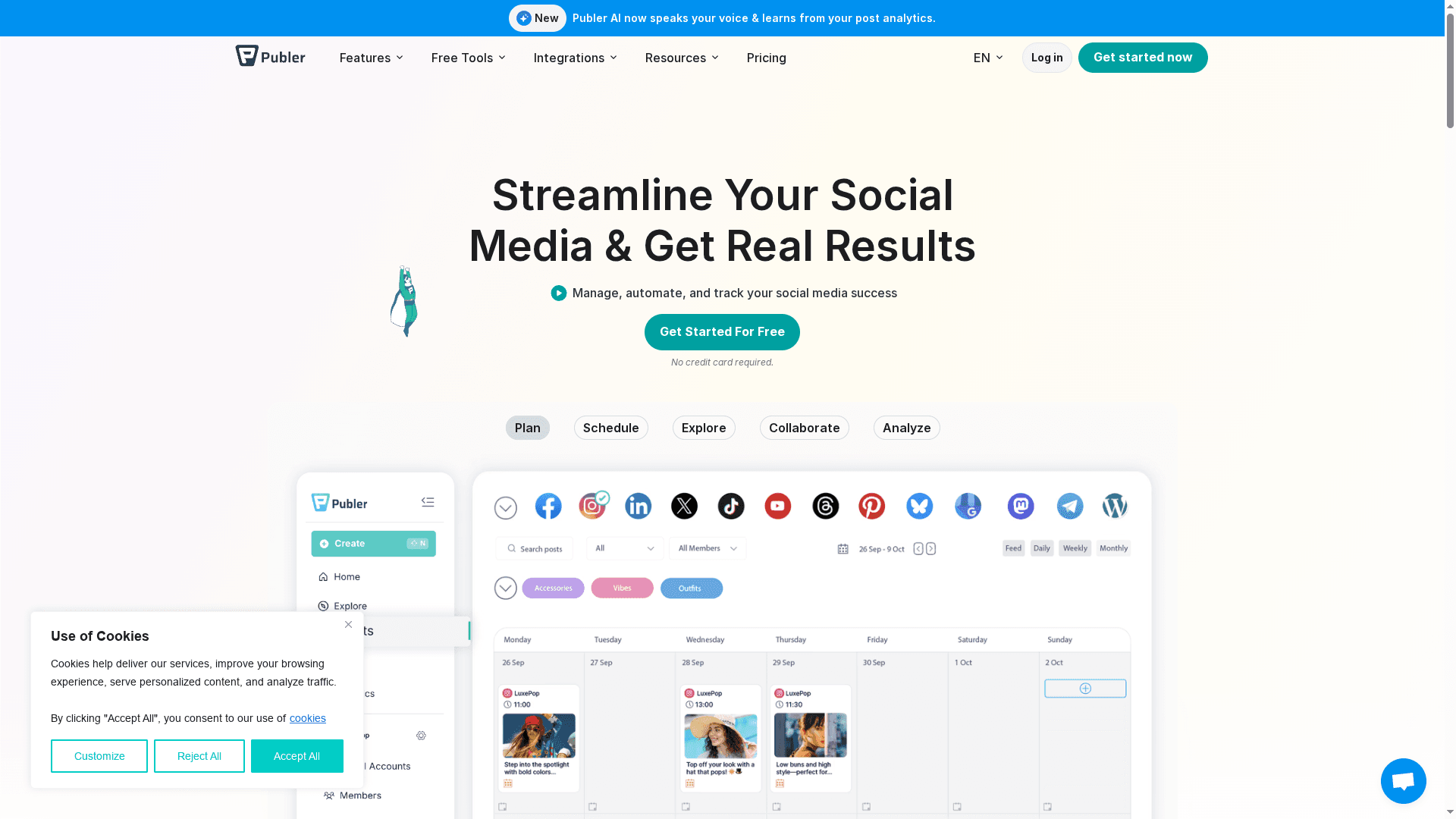
Publer is a full-featured social media management platform built to simplify scheduling, automation, and analytics across multiple networks. For authors and book marketers, it offers practical tools—bulk scheduling, content recycling, and AI-assisted writing—that reduce repetitive work and keep your feed consistent. It’s approachable for solo authors but scalable enough for agencies and marketing teams. Expect a short learning curve for advanced automation, and consider paid plans for larger teams or heavy feature use.
Core Features
Publer centers on cross-platform social media scheduling and automation, with built-in content creation and editing tools so you can craft posts without leaving the app. It supports analytics and insights to track performance, collaboration and approval workflows for teams and clients, and bulk uploading via CSV or a multi-post scheduler for rapid campaign setup. Additional capabilities include AI content generation, link-in-bio management, content recycling, and integrations with popular design and storage tools.
Pros
- User-friendly interface with a drag-and-drop calendar makes planning weeks of posts quick and visual. This lowers the friction for authors who prefer visual scheduling over spreadsheets.
- Comprehensive automation tools including auto-schedule and recycling reduce manual reposting and keep evergreen content working for you. Save time and maintain presence without constant oversight.
- Deep analytics provide the data you need for better decision-making about what content actually drives engagement. That’s crucial when every promotional post should move the needle on visibility or sales.
- Integration with tools like Canva and Google Drive streamlines content creation and asset management. You can pull visuals and drafts into Publer without broken workflows.
- Flexible plans cater to individuals, businesses, and enterprises so you can scale as your audience grows. Start small and upgrade when you need team features.
Cons
- Some features are limited in free plans, which can frustrate users who want to trial advanced automation and analytics. You may hit restrictions before you’ve tested the tool fully.
- Pricing can be high for larger teams or advanced features, making it a significant monthly commitment for agencies managing many client accounts. Budget accordingly.
- There is a learning curve for extensive automation options, so expect to invest time to set up complex recycling or approval workflows correctly. Don’t assume everything will work optimally out of the box.
Who It’s For
Publer is ideal for social media managers, small business owners, content creators, agencies, and enterprise marketing teams who need an integrated platform to schedule, automate, and analyze social content. If you manage multiple author profiles or client accounts and value bulk operations and collaboration, Publer fits well.
Unique Value Proposition
Publer’s value lies in combining practical automation—bulk scheduling, recycling, and AI content assistance—with collaboration and analytics in one interface. For authors, that means less time juggling posts and more time writing, while teams gain clearer approval workflows and measurable performance data.
Real World Use Case
A digital marketing agency uses Publer to schedule and analyze posts across several clients’ accounts, automate content recycling for evergreen promotions, and share drafts with clients for approval—streamlining campaign workflows and reducing manual coordination.
Pricing
Free tier available; paid plans include Professional, Business, and Enterprise with varying features and custom options.
Website: https://publer.io
Author Marketing Tools Comparison
Here’s a comprehensive comparison of popular author marketing tools, showcasing their unique features, pros, cons, and pricing to help authors make informed decisions.
| Tool | Key Features | Pros | Cons | Pricing |
|---|---|---|---|---|
| Digital Marketing Authors | Email, Social Media, AI Marketing Templates & Checklists for Authors |
Proven Author Insights Comprehensive Resources Modern with AI Integration |
Pricing not specified | Not specified |
| Kindlepreneur | Amazon-focused Tools & Courses 500+ Articles, 150+ Videos |
Extensive Free Content Amazon Tools for Sellers Large Audience |
Amazon-centric Focus Some Paywalls |
Free, Some Paid Features |
| Book Brush | 3,000+ Templates Cover Creator, 3D Mockups, Animation |
User-Friendly Time-Saving Tools Affordable Design Solutions |
Limited Advanced Editing Learning Curve Pricing High for Some |
$149-$246/year |
| StoryOrigin | Email & Review Management Newsletter Swaps, Universal Links |
All-in-One Platform User-Friendly Strong Community |
Complex for New Users Most Features Paid |
$0-$10/month |
| Publer | Social Media Management Automation, Bulk Scheduling |
User-Friendly Interface Comprehensive Automation Deep Analytics |
Limited Free Features High Pricing for Advanced Features |
Free, Paid Plans Available |
Master Social Media Marketing for Your Books with Proven Systems
Social media marketing can feel overwhelming when you face scattered tools and unclear strategies. This article highlights the challenge of finding the right platforms and automation to save time while boosting book visibility and sales. If you are struggling to manage posts, engage readers consistently, and turn casual followers into loyal fans, you are not alone. Key goals include simplifying scheduling, maximizing engagement, and leveraging AI-powered content creation to work smarter not harder.
At Digital Marketing Authors, we understand these struggles deeply. Founded by 13x #1 Amazon bestselling author C.T. Mitchell, our platform focuses exactly on helping authors build scalable, repeatable marketing systems—from magnetic email sequences to AI-enhanced social media workflows. We give you templates, checklists, and step-by-step playbooks tailored for authors who want to stop guessing and start selling more books.
Tap into expert strategies that transform your social media chaos into a streamlined engine for growth.
Ready to stop spinning your wheels and grow a loyal reader community with less stress? Explore our proven author marketing frameworks and AI tools now at Digital Marketing Authors. Start marketing smarter today and watch your book sales accelerate with actionable guidance designed for indie authors just like you.
Frequently Asked Questions
What are the essential social media tools for book marketing in 2025?
To effectively market books in 2025, essential social media tools include scheduling platforms for posts, analytics software for performance tracking, and audience engagement tools. Begin by assessing your needs for automation and analytics to select tools that promote consistent engagement with readers.
How do I automate my social media posts for book marketing?
To automate social media posts, utilize a scheduling tool that allows you to queue up multiple posts in advance. Set aside time weekly to create content and schedule posts, ensuring you maintain a steady online presence without daily management.
What metrics should I track to measure my book marketing success on social media?
Key metrics to track include engagement rates, follower growth, and post reach. Focus on monthly reports to analyze trends; for example, aim for a 10% increase in engagement over the next quarter by refining your content strategy.
How can I grow my audience using social media tools?
Use audience engagement tools to create interactive content, such as polls or giveaways, that encourages followers to participate and share. Aim for a campaign that targets a 15% increase in followers within 30 days by offering engaging visuals and dynamic posts.
What types of content should I share on social media to promote my books?
Share a mix of engaging content like behind-the-scenes insights, reader testimonials, and excerpts from your book. Plan a content calendar with at least one promotional post per week to keep your audience engaged and informed.
Can I collaborate with other authors using social media tools?
Yes, many social media tools facilitate collaboration by allowing content sharing and coordinated campaigns. Establish partnerships and plan joint promotions to expand your reach, aiming to increase collective followership by up to 25% within a couple of months.
Recommended

Book Preorder Strategies Explained: Complete Guide
Did you know that authors who use preorders can see up to 30 percent more sales during their book’s launch week? Preorder campaigns are quickly becoming a favorite strategy because they help writers build excitement, measure interest, and earn revenue before release day. By learning how effective preorders work, authors can improve their book’s visibility and connect with readers months before the first copy ships.
Table of Contents
- Defining Book Preorders And Their Benefits
- Types Of Preorder Campaigns For Authors
- Step-By-Step Process For Preorder Success
- Leveraging Email, Social, And AI Tools
- Risks, Costs, And Common Preorder Mistakes
Key Takeaways
| Point | Details |
|---|---|
| Strategic Preorders | Book preorders help authors generate early sales, create buzz, and improve visibility on platforms like Amazon. |
| Campaign Types | Authors can utilize various campaign types including direct platform preorders and social media blitzes to maximize engagement. |
| Marketing Execution | Effective preorder strategies rely on compelling metadata, exclusive incentives, and a multi-channel marketing approach. |
| Avoiding Pitfalls | Common mistakes such as poor timing and inadequate audience targeting can undermine preorder success; authors should navigate these risks carefully. |
Defining Book Preorders and Their Benefits
A book preorder represents a strategic marketing approach where readers can purchase and reserve a book before its official release date. This powerful technique allows authors to generate excitement, build anticipation, and secure advanced sales that can significantly impact initial book rankings and visibility.
Book preorders offer multiple strategic advantages for authors. According to the University of California Press, effective preorder campaigns leverage critical metadata like precise publication dates, compelling book descriptions, and targeted keywords to optimize online discoverability. These advanced sales not only help authors gauge reader interest but also provide crucial momentum for launch week performance.
Key benefits of book preorders include:
- Generating early revenue before official publication
- Creating buzz and anticipation around your upcoming release
- Potentially improving initial book rankings on platforms like Amazon
- Providing authors with early sales data and reader engagement metrics
- Allowing readers to secure their copy in advance of the official launch
For independent authors, preorders represent more than just a sales strategy. They are a powerful tool for building reader engagement and creating a sense of community around your upcoming book. Book launch strategies can be significantly enhanced by implementing a well-planned preorder campaign that connects directly with your target audience.
Types of Preorder Campaigns for Authors
Authors can leverage several strategic preorder campaign types to maximize book visibility and reader engagement. These campaigns range from direct platform-based approaches to more complex multi-channel marketing strategies designed to build anticipation and drive early sales.
According to the Self-Publishing Advice Center, independent authors have multiple promotional avenues to explore. Platform-exclusive preorders typically involve focusing on specific retail channels like Amazon KDP, where authors can offer early purchase options with special incentives. These campaigns often include limited-time pricing, exclusive bonus content, or signed edition opportunities to entice early buyers.
Key preorder campaign strategies include:
Here’s a comparison of popular preorder campaign types for authors:
| Campaign Type | Key Features | Best For |
|---|---|---|
| Direct Platform Preorders | Platform exclusivity Easy setup |
Wide reach Amazon focus |
| Email List Campaigns | Personalized offers Direct connection |
Engaged audiences |
| Social Media Preorder Blitz | Viral potential Short-term buzz |
Brand building |
| Influencer Partnership | Third-party endorsement Wider exposure |
Niche audiences |
| Early Bird Discount Campaign | Limited-time pricing Urgency creation |
Value-driven readers |
- Direct Platform Preorders: Using Amazon, Barnes & Noble, and other book retailer platforms
- Email List Campaigns: Targeting existing readers with exclusive preorder opportunities
- Social Media Preorder Blitz: Creating time-limited promotional events across digital channels
- Influencer Partnership Preorders: Collaborating with book reviewers and content creators
- Early Bird Discount Campaigns: Offering reduced pricing for readers who preorder early
For authors seeking comprehensive marketing approaches, book marketing strategies for authors can provide additional insights into creating successful preorder campaigns that connect meaningfully with your target audience and drive initial book sales.

Step-by-Step Process for Preorder Success
Successful book preorder campaigns require meticulous planning and strategic execution. Authors must approach their preorder strategy as a comprehensive marketing journey that begins months before the actual book launch, carefully crafting each stage to maximize reader engagement and potential sales.
According to the University of California Press, the foundation of any successful preorder campaign starts with compelling metadata. This includes creating an attention-grabbing book description, selecting strategic keywords, and ensuring all publication details are accurate and enticing. Research indicates that authors who invest time in developing high-quality metadata significantly improve their book’s online discoverability and potential for early sales.
The comprehensive preorder process typically involves these critical steps:
- Develop Compelling Book Metadata: Create an irresistible book description
- Build Anticipation: Start promoting 3-6 months before release date
- Create Exclusive Preorder Incentives: Design special bonuses for early buyers
- Leverage Multiple Marketing Channels: Utilize email, social media, and author networks
- Track and Adjust: Monitor preorder performance and adapt strategies
Independent authors looking to refine their marketing approach can find additional insights through bestselling author strategy resources that provide advanced techniques for turning preorder campaigns into powerful book launch mechanisms.
Leveraging Email, Social, and AI Tools
Modern book preorder strategies demand a sophisticated approach that integrates digital marketing channels with cutting-edge technological tools. Authors now have unprecedented opportunities to connect with readers and create targeted, personalized promotional campaigns that extend far beyond traditional marketing methods.
According to the University of California Press’s promotional toolkit, effective author marketing requires a multi-channel strategy that seamlessly combines email outreach, social media engagement, and emerging AI technologies. Email marketing remains a powerful tool, allowing authors to develop direct relationships with readers by creating segmented lists, crafting personalized preorder communications, and designing automated follow-up sequences that build anticipation for upcoming book releases.
Key strategies for leveraging digital tools include:
- Targeted Email Campaigns: Segment reader lists and create personalized preorder invitations
- Social Media Countdown: Use platforms like Instagram and Twitter to build excitement
- AI-Powered Content Creation: Generate engaging promotional materials and social media posts
- Automated Marketing Sequences: Design multi-step communication strategies
- Performance Tracking: Use analytics to refine and optimize preorder approaches
Authors looking to stay ahead of the marketing curve can explore AI strategies for book marketing to unlock advanced techniques for transforming their preorder campaigns into highly effective reader engagement mechanisms.
Risks, Costs, and Common Preorder Mistakes
Book preorder campaigns, while powerful, come with potential pitfalls that can derail an author’s marketing strategy. Understanding these risks is crucial for developing a robust and successful preorder approach that minimizes financial exposure and maximizes reader engagement.
According to the Self-Publishing Advice Center, authors must carefully navigate the financial and strategic risks associated with promotional programs. Platform exclusivity can be a significant constraint, particularly with programs like KDP Select, which may limit an author’s ability to distribute their book across multiple sales channels. The University of California Press warns that neglecting critical elements like metadata optimization can severely impact a book’s online discoverability and potential preorder success.
Common preorder mistakes authors should avoid include:
- Insufficient Metadata Preparation: Incomplete or poorly crafted book descriptions
- Unrealistic Pricing Strategies: Setting prices too high or offering inconsistent discounts
- Lack of Audience Targeting: Failing to identify and reach the right reader demographic
- Poor Timing: Starting preorder campaigns too early or too late
- Inadequate Marketing Follow-through: Not maintaining consistent promotional momentum
Independent authors seeking to mitigate risks and optimize their marketing approach can find valuable guidance through book marketing strategies for authors, which provide comprehensive insights into avoiding common preorder campaign pitfalls.
Unlock the Full Potential of Your Book Preorder Campaigns
If you are struggling with building buzz, optimizing metadata, or creating engaging preorder incentives you are not alone. Many authors find it challenging to navigate the complexities of preorder strategies such as email list segmentation, AI-powered content creation, and managing multi-channel marketing efforts. The pain of launching without a strong preorder plan can lead to missed sales and lost momentum.
At DigitalMarketingAuthors.com, founded by 13x #1 Amazon bestselling author C.T. Mitchell, we understand these challenges and offer proven systems designed to help you market smarter and sell faster. Whether you want to craft magnetic email sequences, leverage AI tools for effective promotions, or build a loyal reader community that drives demand before your book’s release, we provide step-by-step support tailored to your goals.
Ready to stop guessing and start growing your preorder success? Visit DigitalMarketingAuthors.com today to explore powerful book marketing strategies for authors and bestselling author strategy resources. Take control of your book launch and watch your preorder sales soar.
Frequently Asked Questions
What are the main benefits of book preorders for authors?
Book preorders help authors generate early revenue, create buzz around their release, improve initial book rankings, provide early sales data, and allow readers to secure their copy ahead of launch.
What types of preorder campaigns can authors implement?
Authors can use various preorder campaign types, including direct platform preorders, email list campaigns, social media preorder blitzes, influencer partnerships, and early bird discount campaigns to maximize visibility and engagement.
What are the critical steps for a successful preorder campaign?
A successful preorder campaign involves developing compelling book metadata, building anticipation leading up to the release, creating exclusive incentives for early buyers, leveraging multiple marketing channels, and tracking performance to adjust strategies as needed.
What common mistakes should authors avoid when setting up preorder campaigns?
Authors should avoid mistakes such as insufficient preparation of metadata, unrealistic pricing strategies, lack of audience targeting, poor timing in campaign launches, and inadequate follow-through in marketing efforts.
Recommended

Why Self Publishing Works: Complete Author’s Guide
Did you know that nearly half of self-published authors earn over $20,000 each year from their books? The world of self-publishing is expanding fast, giving writers real financial potential and creative freedom that traditional publishing rarely offers. Understanding both the opportunities and challenges of this path can help you navigate the myths and make smarter decisions for your book’s success.
Key Takeaways
| Point | Details |
|---|---|
| Author Control | Self-publishing grants authors complete creative and business control over their work, from editing to marketing. |
| Financial Advantages | Authors can earn higher royalties (35-70%) compared to traditional publishing (8-15%), increasing their overall income potential. |
| Quality Challenges | Despite the benefits, authors must invest in professional services like editing and design to maintain quality in a competitive market. |
| Market Speed | Self-publishing allows for faster time to market, enabling authors to respond swiftly to trends and feedback. |
Table of Contents
- Self Publishing Defined: Core Concepts And Myths
- Types Of Self Publishing Platforms Explained
- How Self Publishing Empowers Author Control
- Financial Realities: Royalties, Costs, And Earnings
- Comparing Self Publishing And Traditional Publishing
- Common Pitfalls And How To Succeed
Self Publishing Defined: Core Concepts and Myths
Self-publishing represents a powerful revolution in book production where authors take complete control of their publishing journey. Unlike traditional publishing routes, self-publishing allows writers to bypass corporate gatekeepers and directly connect with readers through digital platforms and print-on-demand technologies.
According to research from The Guardian, this publishing model has significant economic potential. A 2023 survey revealed remarkable income opportunities: nearly half of self-published authors earned over $20,000, with 28% surpassing $50,000 in annual book revenue. This data challenges traditional publishing narratives about financial sustainability for writers.
Key characteristics of indie publishing include:
- Complete creative control
- Higher royalty percentages
- Faster time to market
- Direct reader engagement
- Flexible pricing strategies
However, self-publishing isn’t without challenges. While democratizing book production, the market faces quality concerns due to reduced editorial gatekeeping. Successful published authors must invest in professional editing, cover design, and strategic marketing to stand out in an increasingly crowded marketplace. Self Publish Archives offer deeper insights into navigating these nuanced publishing landscapes.
Types of Self Publishing Platforms Explained
Indie publishing platforms have revolutionized how authors bring their work to market, offering multiple avenues to transform manuscripts into published books. According to research from Wikipedia, these platforms range from direct DIY digital publishing to more complex service models that provide comprehensive support for writers.
Print-on-demand technology has been a game-changer in non traditional publishing. This innovative approach allows authors to print books only when orders are placed, dramatically reducing upfront inventory costs and financial risk. With best self-publishing platforms, writers can now distribute books globally without maintaining expensive print inventories.
The primary types of self-publishing platforms include:
- DIY Digital Platforms: Direct online publishing with minimal support
- Assisted Self-Publishing: Bundled services with professional guidance
- Hybrid Publishing: Cost-sharing models with partial publisher involvement
- Print-on-Demand Services: Technology-driven printing solutions
Each platform offers unique advantages, but authors must carefully evaluate their specific needs. While some platforms provide extensive marketing support, others focus purely on distribution. Understanding the nuanced differences helps writers select the most appropriate publishing route for their individual goals and budget constraints.
How Self Publishing Empowers Author Control
Author autonomy has been dramatically transformed by indie publishing, giving writers unprecedented control over their creative and professional journeys. According to research from Best Seller Ghostwriting, self-publishing enables creators to make independent decisions about every aspect of their book’s production and distribution.
Traditional publishing barriers have been dismantled, allowing authors to retain complete creative freedom. Self Publish A Book To Boost Your Career highlights how writers can now control critical elements like:
- Book cover design
- Pricing strategies
- Release timelines
- Marketing approaches
- Content editing
The most transformative aspect of self-publishing is its rapid turnaround potential. Authors can potentially complete their entire publishing process in under 90 days, compared to the years-long traditional publishing cycle. This speed empowers writers to respond quickly to market trends, reader feedback, and their own creative impulses, turning publishing from a gatekept process into a dynamic, author-driven experience.
Financial Realities: Royalties, Costs, and Earnings
Self-publishing economics represent a dramatic shift from traditional publishing models, offering authors significantly more favorable financial opportunities. According to research from The Guardian, a 2023 survey of 2,000 self-published authors revealed impressive income potential: nearly half earned over $20,000, with 28% surpassing $50,000 in annual book revenue.
Royalty structures in self-publishing are substantially more lucrative compared to traditional publishing.
 17 Best Self Publishing Companies In 2025 highlights that self-published authors typically earn between 35-70% royalties, compared to traditional publishing’s meager 8-15% range. This dramatic difference means authors retain more of their book’s earnings.
Key financial considerations for self-published authors include:
- Initial production costs (editing, cover design)
- Platform-specific fee structures
- Marketing and promotional expenses
- Potential for higher per-book earnings
- Flexibility in pricing strategies
Successful self-publishing requires treating your book as a business. While the potential for substantial earnings exists, authors must be prepared to invest in professional editing, compelling cover design, and strategic marketing to maximize their book’s financial potential and reader appeal.
Comparing Self Publishing and Traditional Publishing
Publishing pathways represent two distinct approaches for authors seeking to bring their work to readers. According to research from Best Seller Ghostwriting, each route offers unique advantages and challenges that writers must carefully evaluate.
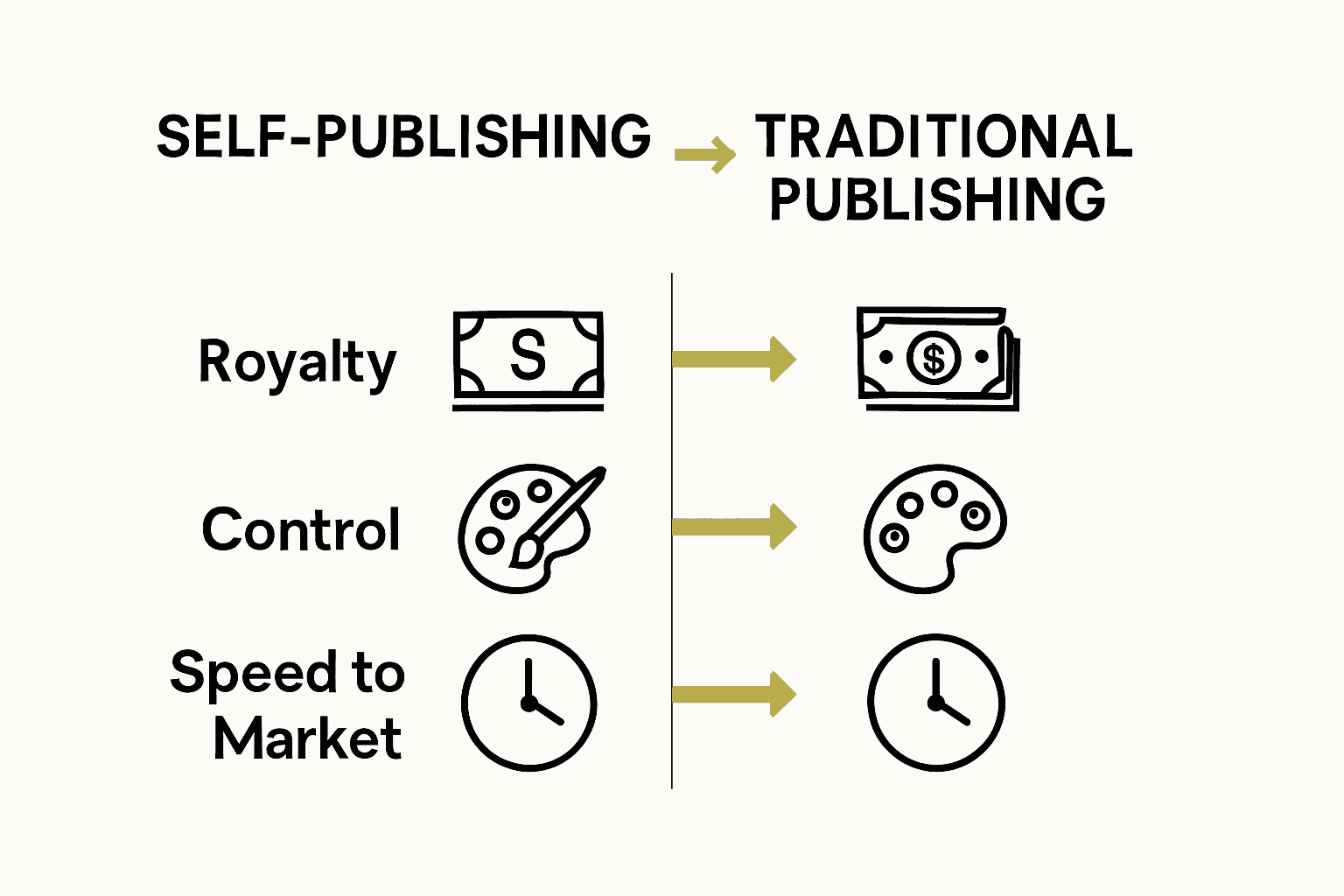
Traditional publishing provides established infrastructure and professional support, including advance payments and industry connections. In contrast, self-publishing empowers authors with complete creative control and significantly higher royalty rates. Self-publishing companies highlight the dramatic differences in financial potential, with self-published authors typically earning 35-70% royalties compared to traditional publishing’s 8-15%.
Key comparative elements include:
Here’s a side-by-side comparison of self-publishing and traditional publishing models:
| Factor | Self-Publishing | Traditional Publishing |
|---|---|---|
| Creative Control | Full author autonomy | Publisher-driven decisions |
| Royalty Percentage | 35-70% | 8-15% |
| Speed to Market | Weeks to months | 1-2 years |
| Upfront Costs | Author-funded | Publisher-funded |
| Distribution | Author-managed | Established networks |
| Marketing | Author responsibility | Publisher support (varies) |
- Speed to Market: Self-publishing (weeks) vs Traditional (years)
- Creative Control: Full author autonomy vs Publisher-driven decisions
- Financial Investment: Author-funded vs Publisher-funded
- Royalty Percentages: Higher (self-publishing) vs Lower (traditional)
- Distribution Channels: Author-managed vs Established publishing networks
Ultimately, the choice between self-publishing and traditional publishing depends on an author’s specific goals, resources, and willingness to manage their own publishing journey.
 While traditional publishing offers prestige and established support, self-publishing provides unprecedented freedom and potential for direct reader engagement.
Common Pitfalls and How to Succeed
Self-publishing success requires more than simply uploading a manuscript to an online platform. According to The Guardian, the current publishing landscape is incredibly crowded, with millions of titles competing for reader attention.
Authors must approach self-publishing as a professional endeavor, not just a creative outlet. Professional production quality becomes critical—this means investing in:
- High-quality cover design
- Professional editing
- Targeted marketing strategies
- Consistent author branding
- Strategic pricing and distribution
The most common mistakes self-published authors make involve underestimating the business side of publishing. Email Marketing Archives suggest that building a robust reader communication strategy is just as important as the book itself. Successful self-publishers treat their books like a business, continuously learning, adapting, and investing in their craft and market understanding. Visibility isn’t guaranteed—it’s earned through persistent, strategic effort and a commitment to producing exceptional work that resonates with your target readers.
Ready to Master Self Publishing and Grow Your Author Brand?
You already know self publishing gives you creative control and better royalties, but turning your manuscript into a bestseller takes more than just uploading your book. If you feel overwhelmed by marketing, building a loyal reader base, or using the right technology to cut through competition, you are not alone. Many writers hit the same roadblocks featured in our guide: standing out, connecting with readers, and creating reliable book sales.
Now is the perfect time to transform your strategy and reach more readers. Discover how Digital Marketing Authors makes it simple to automate sales, grow your fanbase, and scale your author business with proven digital marketing and AI solutions. If you are ready to take charge of your publishing results instead of relying on luck or noisy marketplaces, visit our site for expert guidance. Claim your path to sustainable book profits and author independence today.
Frequently Asked Questions
What are the key advantages of self-publishing for authors?
Self-publishing offers several significant advantages, including complete creative control, higher royalty rates (35-70% vs 8-15% in traditional publishing), a faster time to market, and the opportunity for direct engagement with readers.
What challenges do self-published authors face?
Self-published authors often encounter challenges such as quality control issues due to reduced editorial oversight, the need for professional services (like editing and cover design), and the responsibility of handling marketing and distribution themselves.
How do self-publishing royalties compare to traditional publishing royalties?
Self-published authors typically earn between 35-70% in royalties, while traditional publishers generally offer only 8-15%. This substantial difference highlights the financial benefits of self-publishing for authors.
What are the primary types of self-publishing platforms available?
The main types of self-publishing platforms include DIY digital platforms for direct publishing, assisted self-publishing services that offer professional support, hybrid publishing models that involve shared costs, and print-on-demand services that print books as orders are placed.